
Two of the most vital aspects of injection molding are design of the mold and the product itself, and material selection. These two factors go hand in hand with one another, and selecting the proper injection molding materials is largely dependent on your product’s intended application.
Port Erie Plastics’ engineering team aids in material selection by viewing all of the specs of your product and communicating with your team to identify the best materials that will allow your product to function.
Learn more about how to select injection molding materials based on your product’s application with our guide filled with considerations and best practices.
Define Product Application Requirements
Injection molded products can serve in numerous environments, if the right materials are used to create the products. This is perhaps the most important part of the material selection process as every consideration about the product’s application, including the environment it will serve, must be noted.
Mechanical considerations such as a static, dynamic, or impact loads, product stiffness and flexibility, acceptable wear and friction amounts, and expected fatigue life factor into material selection. Following mechanical considerations, thermal aspects have to be discussed. This can include the standard, continuous service temperature, any peak or lows, thermal cycling, and in some cases, flame rating.
It’s natural to go from thermal considerations directly into chemical exposure and environmental impact. Is your product going to be exposed to oils, coolants, solvents, UV rays, moisture, and/or sterilant? Does your product need to serve both indoor and outdoor, or just one? These questions all need to be considered and answered when selecting injection molding materials.
Certain industries such as the food processing industry or specific regions of the world like the United Kingdom require stringent compliance and regulatory measures on products for biocompatibility and food-safe materials, or an RoHS compliance in electronic components.
And then a final consideration to make is from a visual standpoint. How does the product need to look? Will there be any secondary operations necessary and can the material withstand those operations?
When all of these questions and considerations have been made, it provides the roadmap to acceptable materials to use in your product.
Injection Molding Materials Based on Performance and Costs
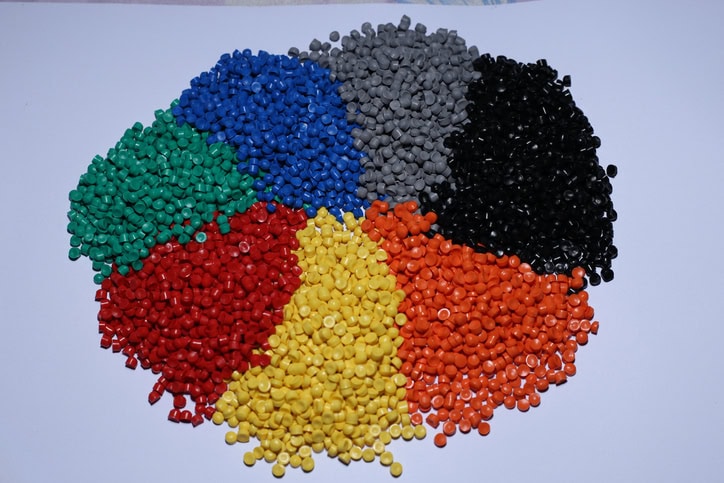
There are over 85,000 plastic materials readily available, but that doesn’t mean they all work as injection molding materials. The most common type of polymer used are thermoplastics, a class of polymer that can be liquified at high temperatures and then cooled into a specific shape. Consider these three groups when thinking about injection molding materials.
- If your team needs low-cost materials that also have easy processing capabilities, materials such as polypropylene, polyethylene, polystyrene, and acrylonitrile butadiene styrene. These materials are commonly found in many consumer goods, packaging, and simple housings.
- If materials need to have better heat, chemical, and mechanical properties, and your team’s budget has a little more room for spending, polycarbonate, nylon, POM, PBT, or PET polymers could be a solution. These materials are all frequently seen in the automotive, electrical, and industrial industries.
- If your team needs the highest performance injection molding materials where cost isn’t a factor, PPS, PSU, PES, and PEEK should be researched for your program. It’s common to see these materials used to create parts for the medical and aerospace industries as they can withstand consistent high temperatures and aggressive chemicals.
Contact Port Erie Plastics for More Information on Injection Molding Materials and Making the Best Choice
Port Erie Plastics are experts in plastic processing manufacturing, operating out of our Harborcreek, Pennsylvania, facility. We perform various kinds of plastic manufacturing including injection molding, plastic extrusion, and structural foam molding.
As a turnkey injection molding partner, our engineering team works tirelessly to aid our customers in selecting the right injection molding materials to ensure manufacturability for their products and that they can survive in their intended application. We work with your team to understand your needs and your product’s application to narrow down the material options and select the right material.
Contact us today to learn more about the material selection process with Port Erie Plastics and let’s take your product from blueprint to serving in the real world.