

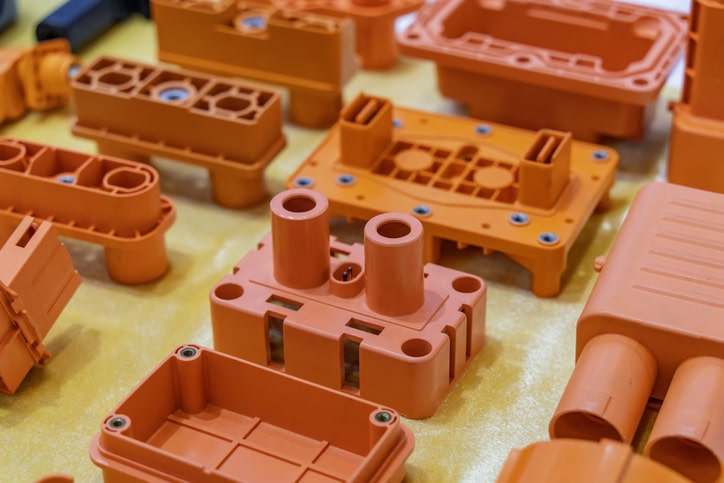
There are multiple different manufacturing methods available to create large plastic components. Depending on the specs of your project, thick wall injection molding or structural foam molding might be two viable options for your team to consider.
Each manufacturing operation contains their own sets of benefits, best applications, and certainly their own process. But, how to tell which is right for your product?
Port Erie Plastics pits these two manufacturing operations against one another in the pursuit to find out which is best for large plastic component manufacturing.
Best Uses for Each Manufacturing Process
Thick wall injection molding and structural foam molding each are capable of creating large plastic components, but these two manufacturing operations should be used with specific considerations and project criteria in mind.
Thick Wall Injection Molding
Consider using thick wall injection molding for projects where wall thickness is more moderate and manageable rather than extreme. When parts need tight dimensional control and high, easy repeatable actions and better scalability, thick wall injection molding should be the go-to. Traditional injection molding already lends itself to high-volume capabilities, and even though the wall thickness might be larger than normal, the process still lends itself to high-volume manufacturing capabilities, just with a longer cycle time.
Structural Foam Molding
When parts are large, extremely thick, or highly ribbed, this is where the conversation should shift toward structural foam molding. The process uses low pressure and a cellular core with solid skin to create parts where stiffness to weight ratio is improved. Additionally, sink marks and warpage are greatly reduced because of the low pressure.
Structural foam molding better supports large molds and the materials required for tooling can be much more cost-effective since cavity pressures in the processes are lower.
Tradeoffs
Choosing one manufacturing process over the other means not having the capabilities of the passed over manufacturing operation. If your team decides on structural foam molding, you are forgoing manufacturing of complex designs, tight tolerances, and smoother aesthetics.
If the choice is thick wall injection molding, you’re passing on lower clamping forces, lower tooling costs, better stiffness, and overall lighter parts.
Large Component Focus
In general, large plastic components are going to be more favorable for structural foam molding to perform the manufacturing. This stems from the cost-effectiveness of the process and its ability to handle large component manufacturing with relative ease. While it’s more favorable, if parts do feature complex designs and intricate shapes or tight tolerances, the heavier costs of injection molding are likely to be endured.
Achieve High-Quality Thick Wall Injection Molding Services and Partner with Port Erie Plastics Today
Port Erie Plastics has operated as a plastic processing manufacturer equipped with multiple capabilities for over 70 years. When we opened for business in 1953, we did so with a single injection molding machine. Since then, we’ve turned that single machine into 90 with maximum clamping forces of 1,650 tons, shot sizes up to 470 ounces, and parts weighing as much as 24 pounds.
Of course, injection molding isn’t the only manufacturing operation we perform in our Harborcreek, Pennsylvania, facility. If your program isn’t a match for injection molding, we also perform structural foam molding operations, and our engineering team can work with you to transform your design from injection to structural foam molding with ease.
Thinking about starting a thick wall injection molding program? Contact the experts at Port Erie Plastics today.